Access follows the project
Planned organization, project, and member roles give your team a common access model across editing, review, and rendering.
Alchemist Server
The planned home for shared projects, media, review, and rendering on infrastructure you control. One service architecture, connected to the Alchemist tools your team already uses.
Planned · Self-hosted serviceOne identity. One project. One media library.
01 — Your deployment
Server is planned as the common home for a team's work. Project access, media delivery, and render jobs belong to the same deployment.
Planned organization, project, and member roles give your team a common access model across editing, review, and rendering.
The planned media layer registers verified assets, supports resumable uploads, and serves proxies through expiring links.
API, media, and rendering are being designed together. Start with the services your workflow needs, without introducing a separate account system for each.
Server connectivity will extend Alchemist Web. Review and share-link playback come first; connected editing follows.
The desktop plan adds account sign-in, a Server media provider, and a publishing workflow within Alchemist Pro.
Compose packaging, documented upgrades, and backup and restore are planned. Kubernetes deployment follows the self-hosted foundation.
02 — The rendering foundation
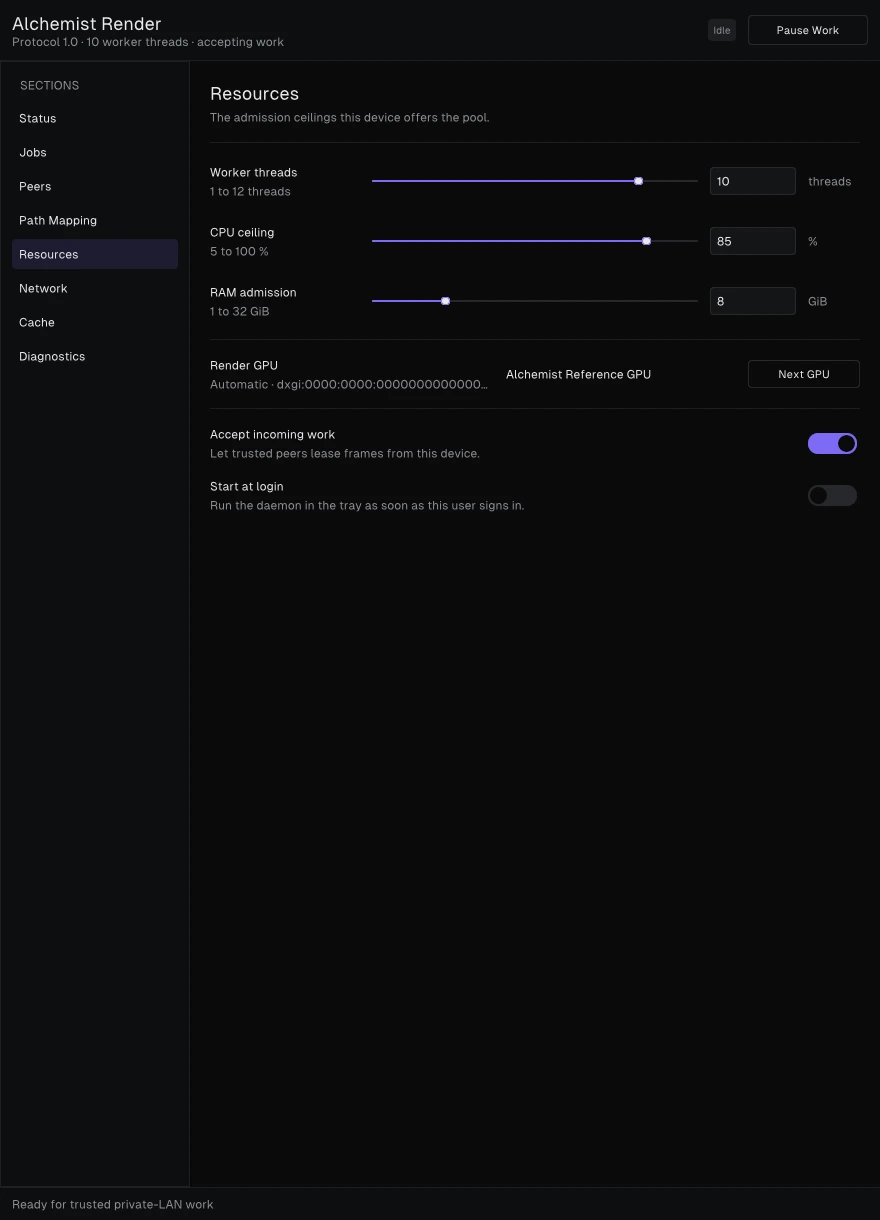
Alchemist Render is the existing private-LAN companion to Pro. Its job tracking, worker controls, and verified media transfers are the foundation for the planned Server render service.
The native manager exposes worker threads, CPU ceiling, RAM admission, and cache quota, with controls to pause or disable incoming work.
The LAN pool pairs devices explicitly and uses authenticated transport. The hosted service will introduce a separate organization-based access model.
Content identities, checked media blocks, and tracked frame artifacts underpin resumable work. Server is planned to carry these foundations into a managed render queue.
03 — The path to Server
The native roadmap moves from a private render pool to Linux workers, then to a self-hosted service and larger fleets. These are delivery stages, not announced release dates.
The native companion already provides job tracking, trusted peers, resource controls, and verified transfers. Cross-platform acceptance remains part of the release process.
A new headless worker will reuse the rendering foundations. Source decoding and output certification must be proven before a worker can accept a job.
Shared identity, a media registry, project access, and the render queue come together behind one Server deployment.
Kubernetes packaging, queue-driven scaling, and operational validation follow the self-hosted release.
04 — Deployment scope
Server's deployment model is still on the roadmap. The existing desktop editor and LAN companion remain macOS and Windows applications.
| Area | Stage | Direction |
|---|---|---|
| Server host | Planned | A headless Linux service; no desktop UI host required. |
| Team access | Planned | Organization and project roles, revocable credentials, and self-hosted identity integration. |
| Media storage | Planned | S3-compatible storage, verified uploads, expiring media links, and range requests. |
| Render service | Planned | Job submission, worker enrollment, progress, and delivery under the same Server identity. |
| Deployment | Planned / later | Compose first, followed by Helm and larger fleet operations. |
| Alchemist Render | Existing foundation | Private-LAN application on macOS and Windows; separate from the future Linux service. |
Across the suite
Choose the editing surface and operating model that suit your team.
Follow the development of Alchemist Server and tell us how your studio works.
Server is planned. Join the waitlist for availability updates.